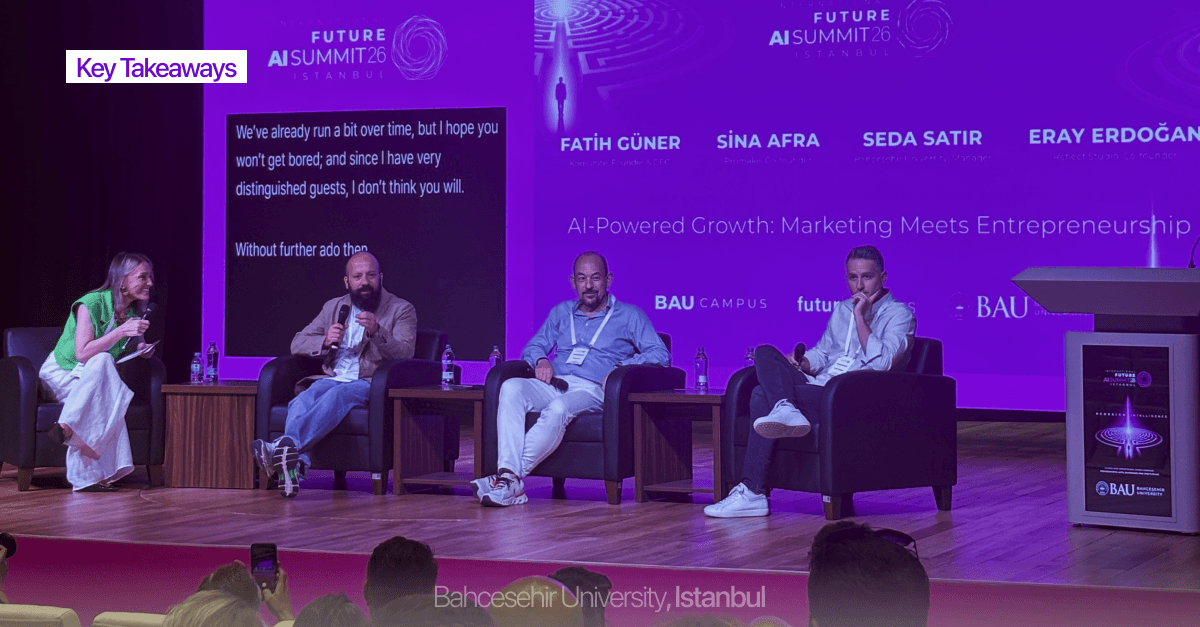
Over two days at Future AI Summit 26, held at Bahçeşehir University in Istanbul, I had the chance to listen to leading academics and senior leaders from Amazon, Adobe, Huawei, and other global companies — their mindset around AI, the philosophy behind their work, what they are building today, and where they see the field heading. Startup workshops added another layer: founders presenting their ideas up close, and plenty of room to see creativity in action.
In this post, I will share the takeaways that stayed with me from the event.
Overview
Future AI Summit brought together people from different cultures, genders, professions, and ways of thinking — including very different attitudes toward money, risk, and value creation. When you step back from the day-to-day technical debates and look at AI from a higher vantage point, something becomes clear: the excitement in the room is not hype for its own sake. It is the sense that a genuine shift is underway, and that the AI wave is moving fast enough to reshape how companies operate, not just how they market themselves.
What stayed with me goes beyond engineering. The countries that did not only pioneer this field but continue to push it forward share something in common: progress is not driven by code alone. It grows out of interaction between people with different ideas, interests, and cultural backgrounds — creativity meeting discipline, startup energy meeting institutional scale. Hearing that mix on stage made it easier to see why entrepreneurship and real added value matter again in this cycle.
I came back with another conviction as well. Türkiye’s push in this space, and events like this one led by universities that create room for that kind of cross-disciplinary exchange, can matter even more than another keynote about models or tools. The summit was not only about what AI is — it was about who gets to shape it, and what that takes beyond the lab.
Perhaps the short name for all of this is vision. Institutions that keep education trapped inside a triangle of instruction, money, and mathematics alone will, in the end, fall behind in the race. The agile ones — the ones hosting events like this — are trying to move teaching forward along a different axis: creativity and value. That shift was visible in how the summit was designed, not only in what was said from the stage.
Key Takeaways
1. Prof. Dr. Haluk Görgün — Secretary of Turkish Defence Industries
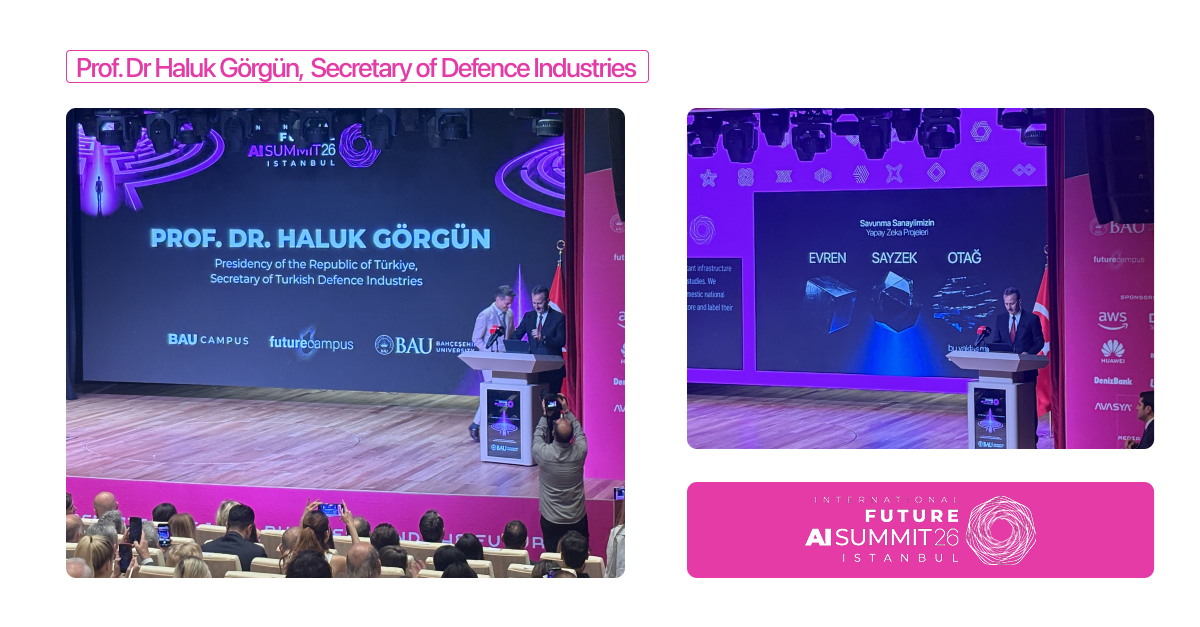
Prof. Dr. Haluk Görgün, Secretary of Turkish Defence Industries — Future AI Summit '26, Istanbul.
Firstly, I would like to address the opening speech of Prof. Dr. Haluk Görgün, Secretary of Turkish Defence Industries. From his remarks, it is possible to understand that they identify real problem domains and take action so that the Republic of Türkiye does not fall behind in the field of artificial intelligence — but rather advances toward a leading position.
This is a structure that develops rapidly and demands continuous change. To carry it forward, the emphasis falls on providing opportunity to bright minds who have the most time — those who practice learning to learn. In pursuit of that goal, they have introduced a platform named Evren. It may be described as a local Roboflow - Hugging Face; however, unlike credit-based models where balance decreases with use, Evren offers a GPU environment for AI built on the opposite principle — where capacity increases as it is used.
Rising graphics card and server costs mean that many talented people no longer have the time or means to work on their ideas. In that context, this step is of considerable importance: it aims to ensure that the creativity of bright minds is not left behind. Personally, I had not been aware of this platform before the summit; that may reflect a shortcoming on my part. Even so, I left with the conviction that its promotion could be made more effective.
2. Hervé Marchet de Meurival — Head of Education, Amazon Web Services
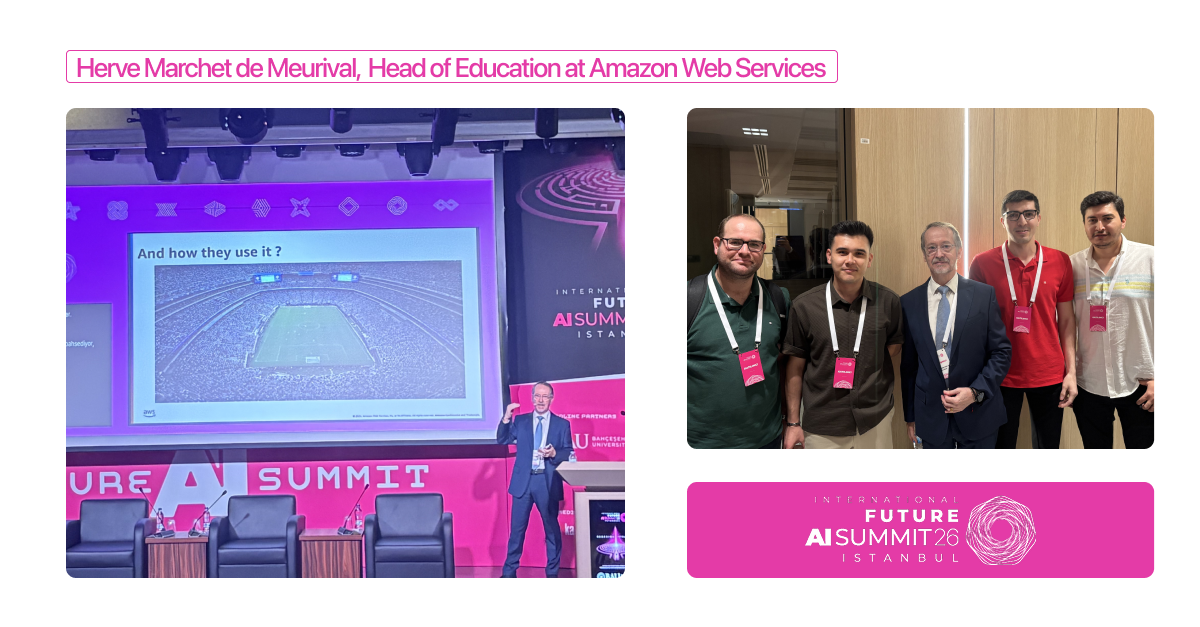
Hervé Marchet de Meurival, Head of Education at Amazon Web Services — Future AI Summit '26, Istanbul.
The second session I would like to note was delivered by Hervé Marchet de Meurival, Head of Education at Amazon Web Services. His presentation addressed the real-world applications of artificial intelligence in education, and the orientation toward change in his own life and PhD training process. It was an excellent talk — and Hervé was genuinely impressive for his presentation skill as much as for the content.
I also had the opportunity to speak with him outside the hall. On the subject of AI tools being developed for education, we held different views. I share the concern that such tools may, children in particular, hinder certain abilities — discipline, regard for rules, and related habits; studies and articles have suggested that less attention is paid to these when AI is introduced without care. Product development in this space, I believe, needs to account for that risk. Our conversation reflected that difference in perspective rather than a shared conclusion.
3. Ray Rui — CEO, Huawei Cloud Türkiye
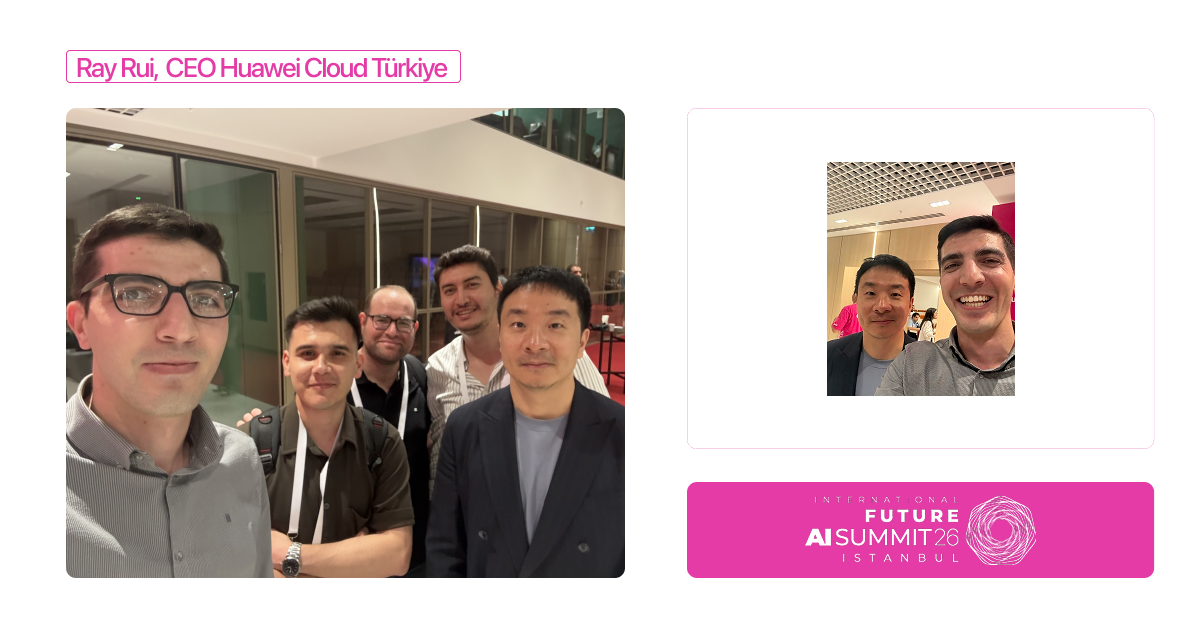
Ray Rui, CEO of Huawei Cloud Türkiye — Future AI Summit '26, Istanbul.
At the summit, we also had the opportunity to meet Ray Rui, CEO of Huawei Cloud Türkiye, which operates in our country. I believe that China’s continued position as a leading nation in artificial intelligence, manufacturing, and many other fields — maintaining and advancing its level despite the international difficulties it faces — sets an important example for Türkiye.
4. Fatih Güner — CEO, Komünite (AI-Powered Growth Panel)
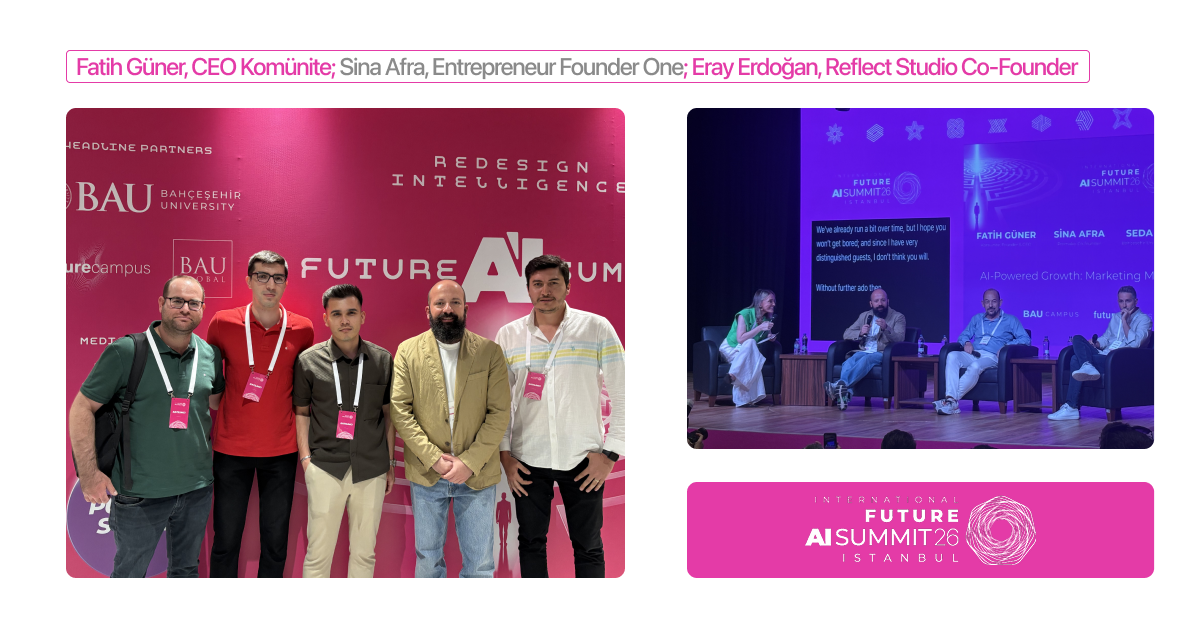
Fatih Güner (Komünite), Sina Afra (Founder One), and Eray Erdoğan (Reflect Studio) — Future AI Summit '26, Istanbul.
This was, for me personally, the session from which I took away the most lessons and the one I enjoyed the most. Although the speakers on stage carried similar titles, it was a pleasure to see that each had built success through a different world — shaped by thought and creativity — and that something worth learning could be drawn from every remark.
Above all, I came away with a clearer sense of how important it is to understand and apply human sociology — not only in founding a startup, but in doing any work well. The panel held both the stage and the audience with real skill.
One line from this team I will not forget: in the success of an artificial intelligence product, only twenty per cent is technology; the remainder is tied to different fields of interest, cultural breadth, relationships, and much else besides. I agree with that view entirely.
My own addition to it is this: reading widely and meeting people from different walks of life are among the most important dimensions of this field — perhaps as much as any technical skill on the slide.
5. Prof. Dr. Serdar Durdağı — Dean, Bahçeşehir University
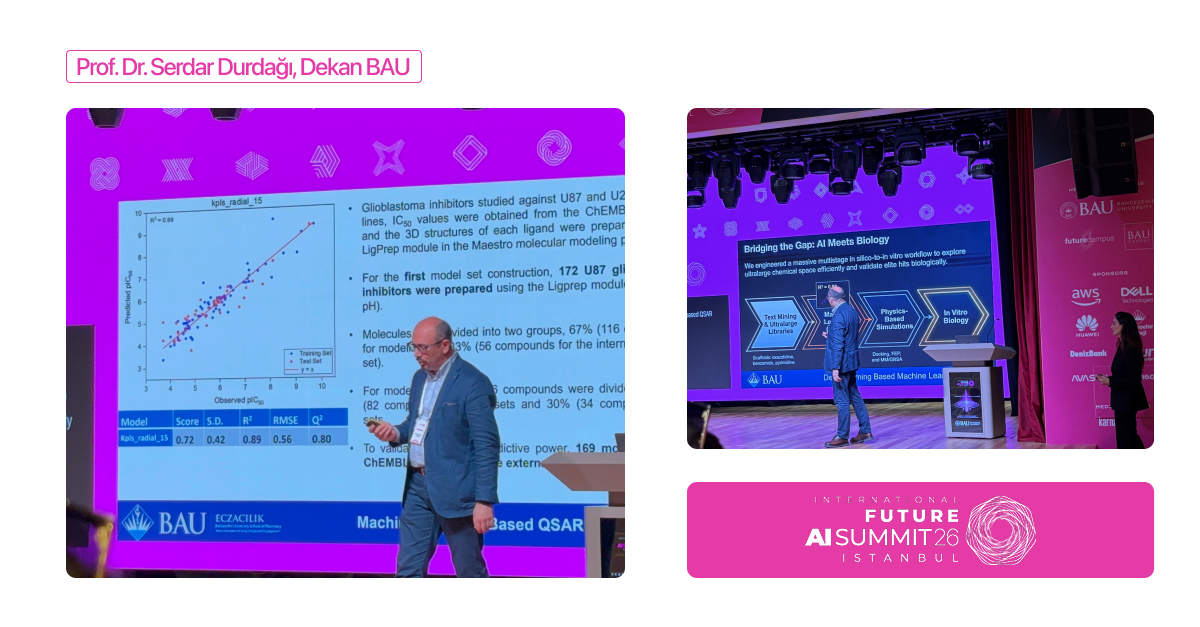
Prof. Dr. Serdar Durdağı, Dean of Bahçeşehir University — Future AI Summit '26, Istanbul.
Another session worth noting was delivered by Prof. Dr. Serdar Durdağı, Dean of Bahçeşehir University. It was a highly academic, statistics-driven presentation. To the extent I could follow it, the work addressed the early-stage prediction of cancer through the molecular composition of cancer cells — with substantive suggestions above all on data labelling, and prediction models supported by strong R-squared statistics.
I am not a specialist in this domain, nor am I fluent in its terminology. Even so, I found it impressive to sit through the talk without leaving the hall and to watch, attentively, what machine learning can accomplish in such a field. I made an effort to follow and understand, prioritising the three or four points I felt I could still carry away and apply. In its own way, that session was an important reflection of the interest this summit drew to artificial intelligence — including from audiences who do not work in the subject every day.
6. Other Presentations
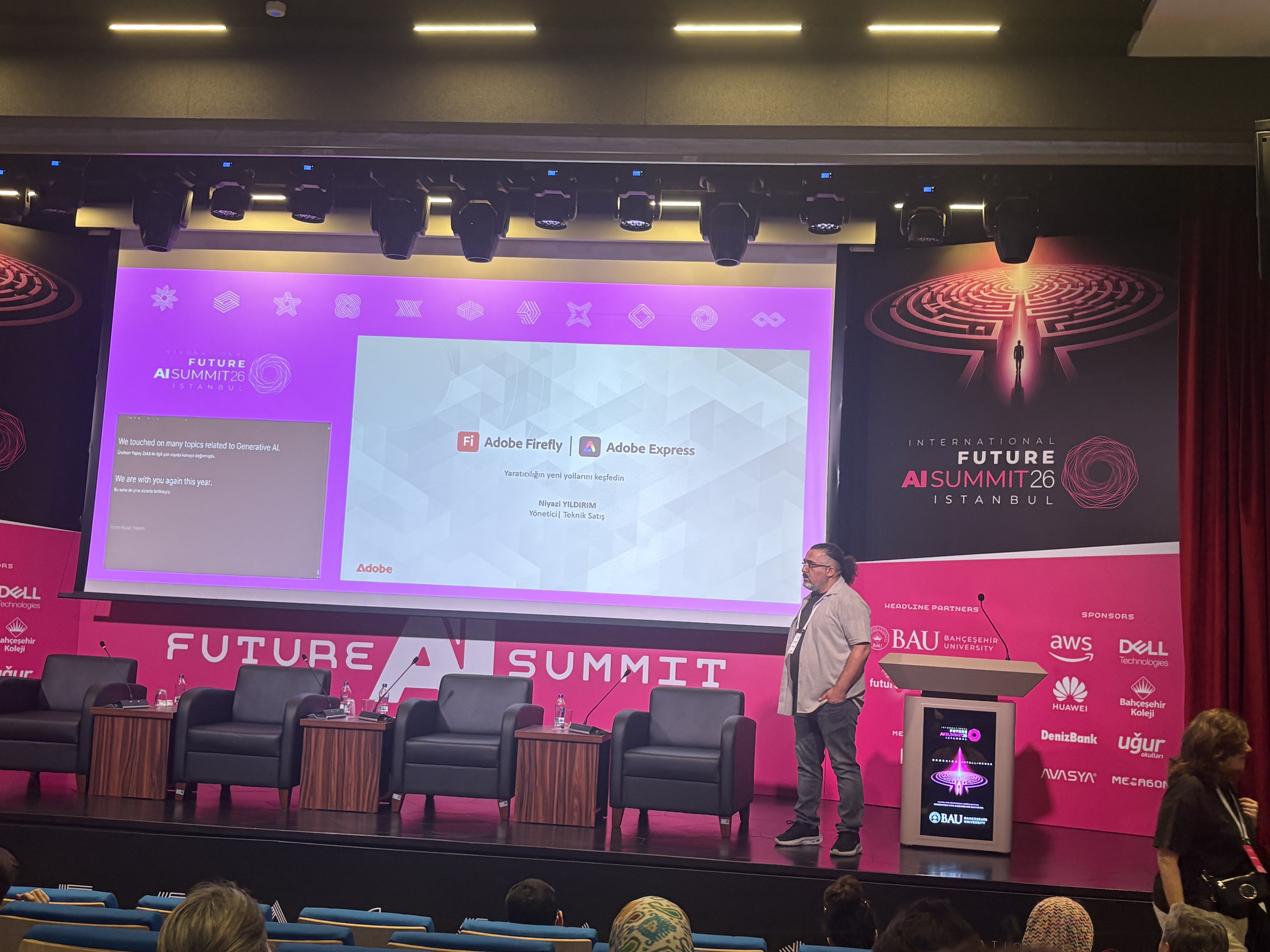
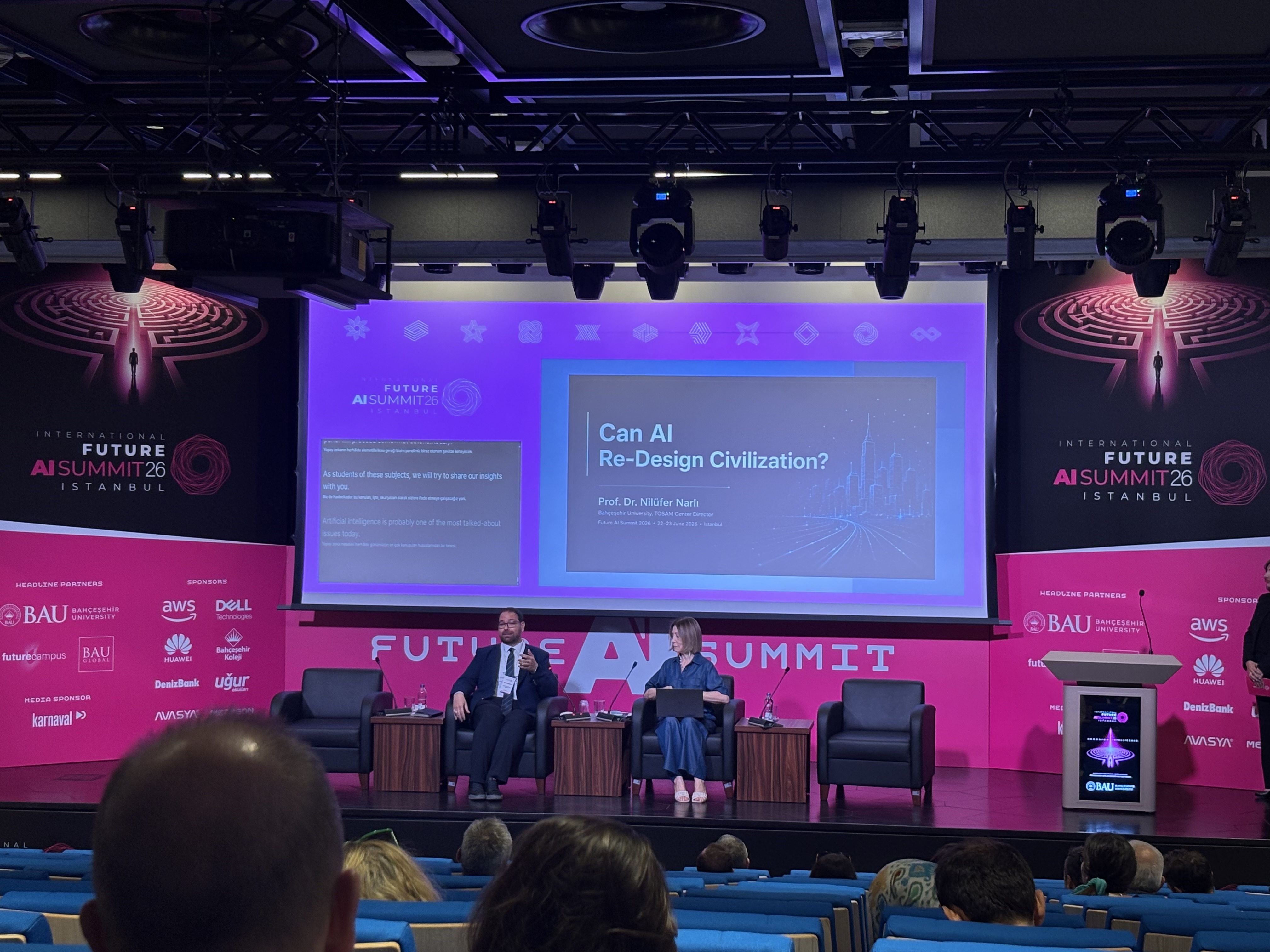
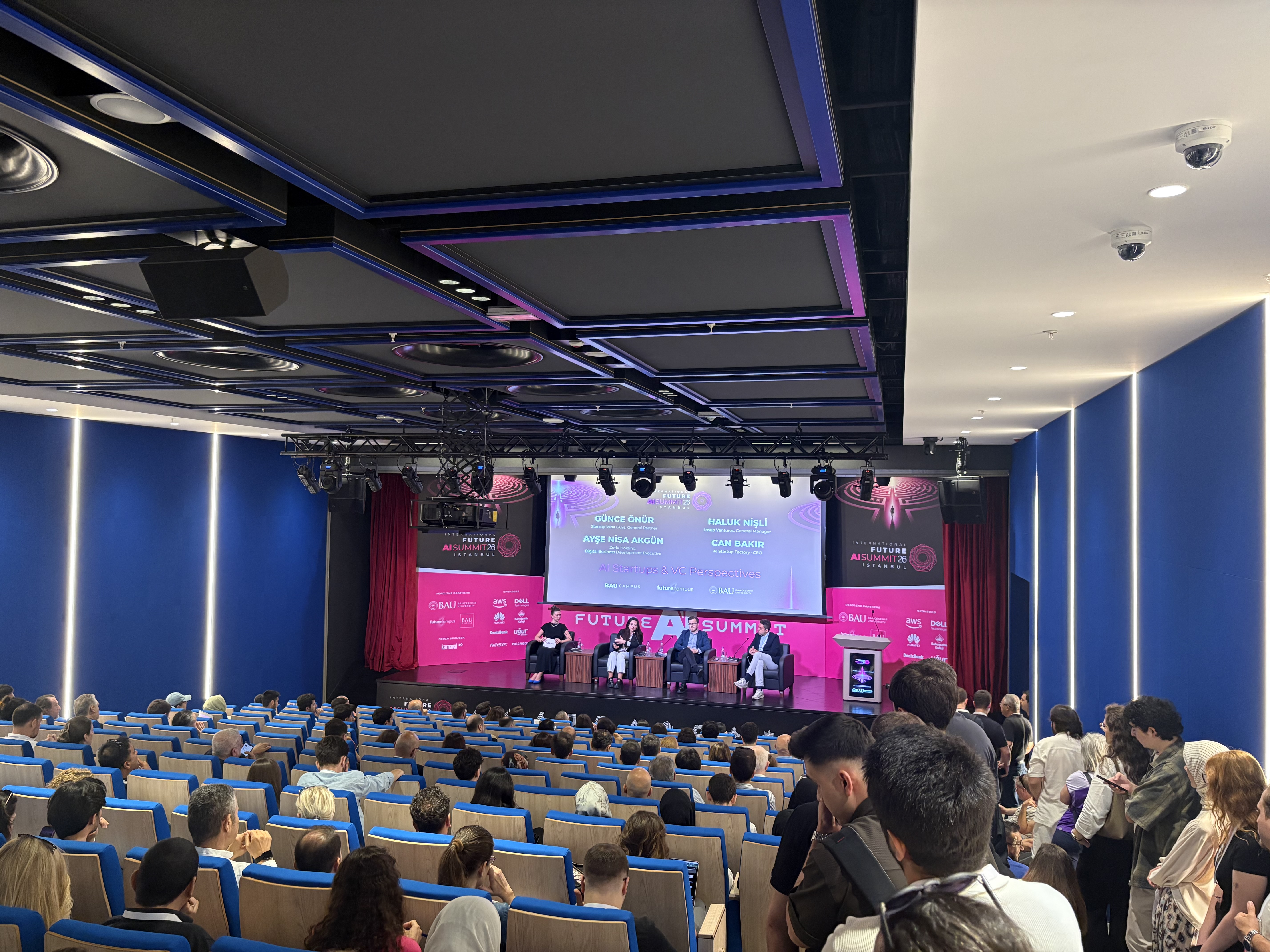
The Adobe Firefly presentation sat, to some degree, between explaining what the product does and promoting it — and one could read parts of it as advertising. Even so, one detail stood out.
On copyright, the talk addressed what happens when visuals are produced through text-to-image tools or comparable alternatives: Adobe has put in place insurance of ten thousand dollars per production so that, in the event of a dispute or lawsuit, losses can be compensated. That is a striking point. It suggests that law and respect for content are being thought through in connection with artificial intelligence — not left as an afterthought. In its own way, that kind of messaging, even inside a promotional session, hints at a maturing path for AI: not only louder claims, but structures that begin to answer what happens when generated work meets the real world.
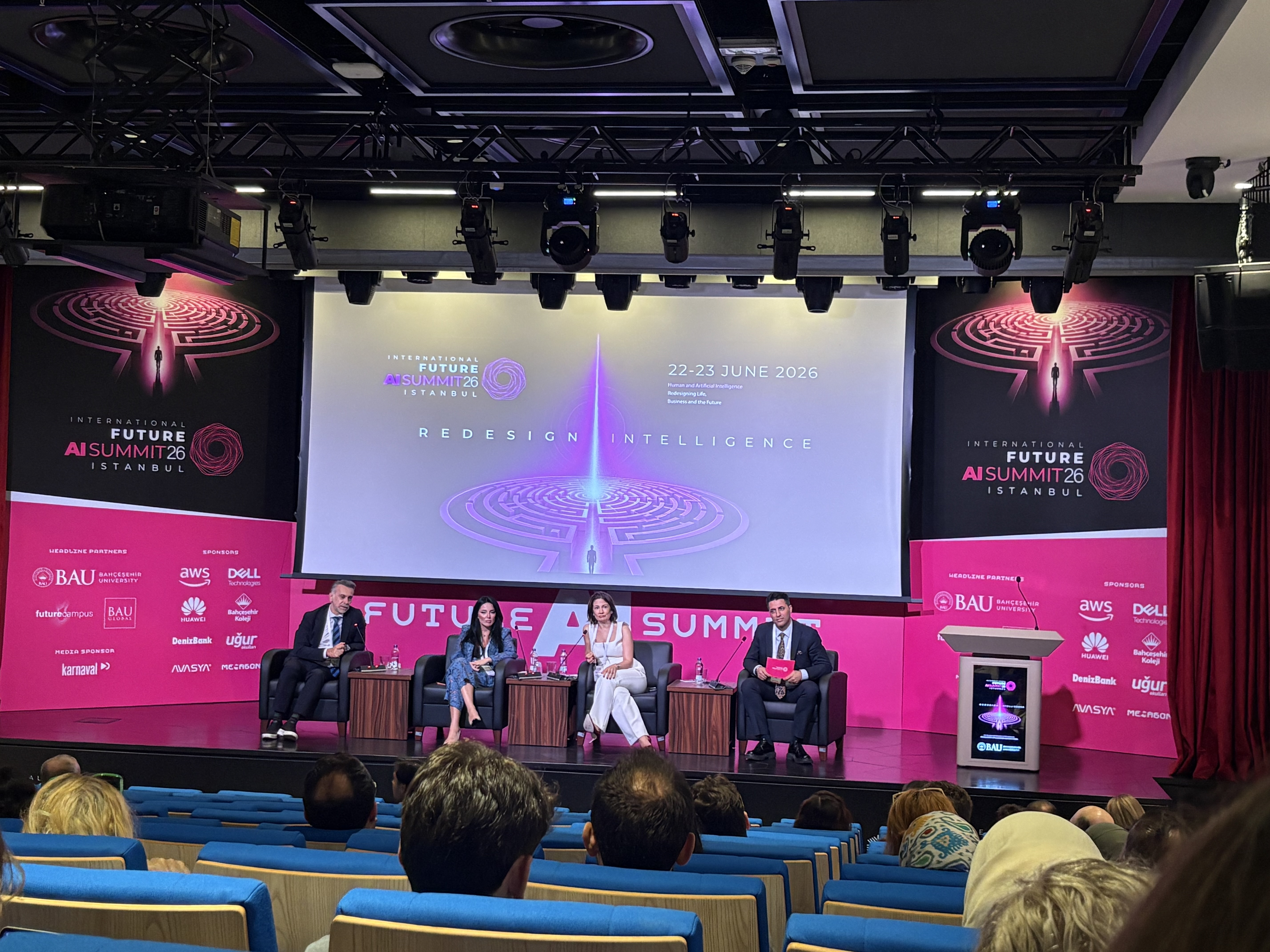
It should also be noted that a remarkable session took place on investment in technology startups — with voices from the banking sector, from companies, and from individual and institutional investors who put capital behind new ventures. What stood out was how, together with artificial intelligence, investment processes, the pace of change, teams, and the mechanisms of thought and capital allocation are all being reshaped. It was, in its own right, an excellent panel.
7. Startup Workshop
As a closing note, the startup workshop made a lasting impression. Beyond the atmosphere of the space itself — where we could see dozens of startup ideas and the people behind them — it was a pleasure to speak one on one with companies that had opened booths: to hear their expectations and to see their remarkable products up close. That direct contact was, in every sense, excellent.